Mick Feyaerts is a doctoral researcher at the research group History of Modernity and Society (MoSa) at KU Leuven. In four blog posts, she will be sharing some reflexive notes about her research trip in Kikwit (October 2023), during which she engaged in archival research, oral history interviews, and participant observation among Catholic sisters. Her Ph.D. project explores the postcolonial evolutions of the Roman Catholic Church in Kikwit – more specifically, she focuses on sister congregations and the hybridity that has characterized these multinational, multicultural, and multiracial institutes. How do sisters make sense of the intertwinement of their congregation’s history with colonization? What identities do they build for themselves and how does history function in that process? What place do they occupy in contemporary urban society? In the following four weeks, she will reflect on these questions.
[Part 4] Sisters & the City
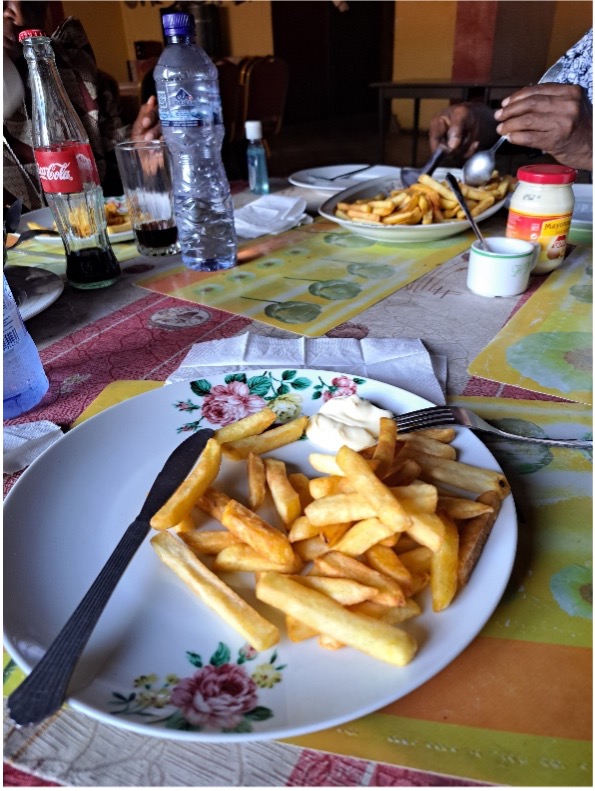
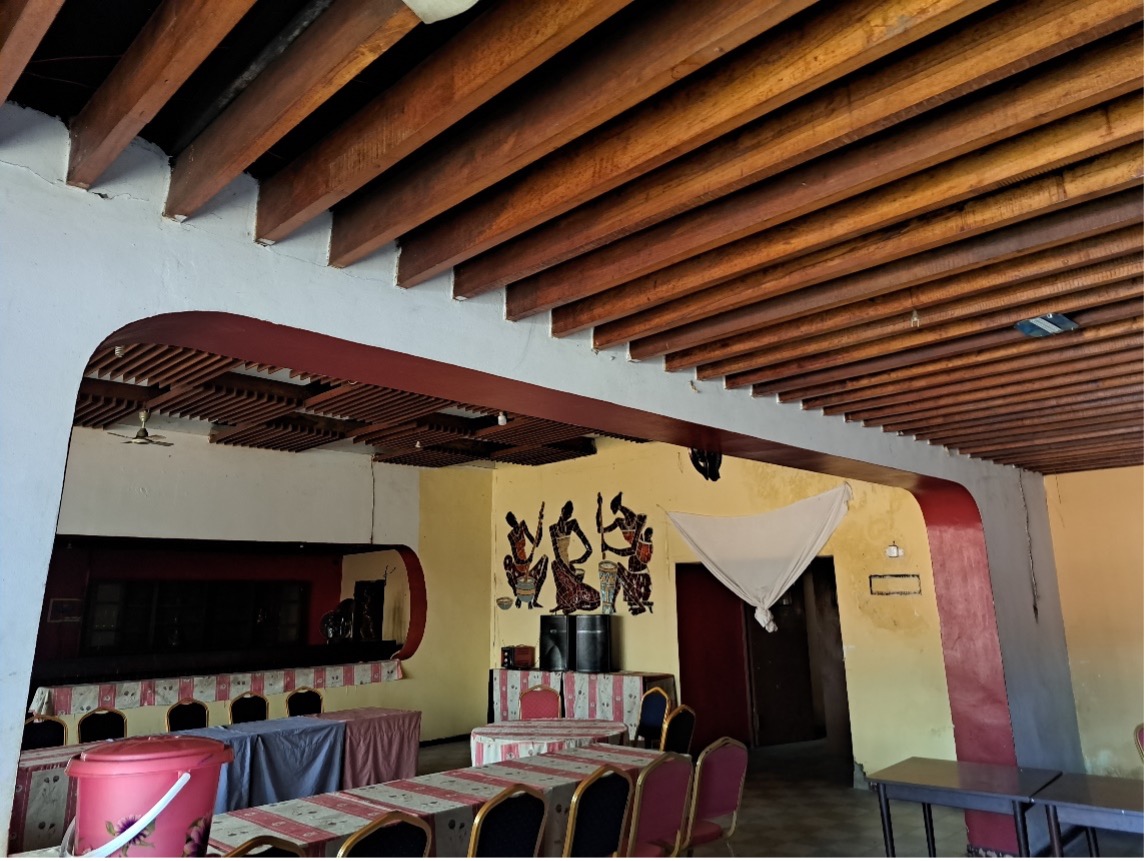
On a particularly hot Monday in October, when no more than a few single drops of rain teasingly fell from the sky, sister Arlette* took me to abbé Mbuluku, a well-known priest living in the curia of the diocese. Not only did he generously share his knowledge of the history of the local Roman Catholic Church with me, but he also mobilized his driver to take sister Arlette and me out for lunch in the Hotel Kwilu, an old colonial hotel (inaccessible to blacks until Congo’s independence from Belgium in 1960). Abbé Mbuluku had arranged for the hotel to set us a table in the otherwise empty dining hall, where we drank Coca-Cola and ate fries with pork meat. Sister Arlette made sure to emphasize that this lunch date was THE high day of my stay: I was able to eat fries in what is believed to be one of the city’s architectural pearls, proving that “Congo is not all misery”. Simultaneously, it also illustrated to me the network and leverage that Catholic sisters have in the city. They know the right people, who can get them into quite exclusive places. I soon learned that Catholic sisters indeed occupy a central position in the city.
Their missions lead them to execute functions crucial to the well-functioning of urban society. Many of them teach on all possible levels of Kikwit’s educational system. Sister Arlette instructs applied pedagogy at the Institut Supérieur Pédagogique, the city’s college, while sister Jeanne* (part 2) is an assistant professor in mathematics at that same institution. Other sisters teach in primary or secondary schools or execute management functions in those same institutions. Sister Carole* (part 3) is the prefect of Lycée Siama, the city’s prestigious secondary school for girls, and her consœur, sister Murielle*, manages the institute’s boarding school. Sister Elisabeth*, a sister Annonciade, is prefect and history teacher of a secondary school in Kikwit Kaggwa, one of the parishes on the left bank. Other sisters I met serve as headmistresses or student counselors in other schools. These functions make them very visible and well-respected figures among the city’s young population.
Also in the city’s health care system Catholic sisters occupy pivotal functions as nurses, managers of medical facilities, or small-scale entrepreneurs. Examples abound. The Suore delle Poverelle di Bergamo, an Italian congregation that arrived in Kikwit in 1956, specializes in medical care – their sisters have always worked as nurses in the city’s general hospital. Sister Chantal, the local superior of the Annonciade maison mère in Kikwit, was trained in gestion des facilités médicales and effectively managed a small centre de santé before becoming superior in 2016. The city’s pharmaceutical depot, which was founded in the 1980s and distributes medicines in the entire diocese, is currently under the directory of a sœur de Marie au Kwango, an autochthonous congregation founded in 1937. The Annonciades run a small optician store, aiming to provide Kikwit’s population with high-quality, affordable glasses.
Moreover, in a city with a Catholic population of about 60%, there are many pastoral tasks to fulfill. Sisters engage in catechism, youth movements, and community building initiatives, assist in masses (such as leading the church choir, or collecting the financial contributions of the churchgoers), and run diocesan initiatives such as a book store, … In addition to this, sister communities are often real entrepreneurial units, attempting to become financially self-sufficient (auto-financière). They organize small-scale businesses, such as the optician or selling potable water from a well on their estates; operate farms on multiple scales, cultivating their own vegetables and meat and selling any surplus; and run maisons d’accueil in which they host guests for reasonable prices.
All these activities make the Catholic sisters well-known figures in society, and that became quite clear during my trips around the city. No matter who I was with, the sisters were always greeted with hearty “mbote”-s and “bonjour masœur”-s, and often we had to stop for a little chat. Sometimes it was obvious that the passers-by were primarily curious about the young white woman (me) standing rather shyly and sweaty next to the sisters, but just as often they seemed to hardly notice me. Moreover, sisters always greeted one another.
Archival material in missionary institutes in Belgium had already taught me that, historically, congregations never operated in isolation in Congo – there had always been a great deal of collaboration between sister congregations. However, during my research trip, I was able to grasp more thoroughly how extensive these contacts actually are. Not only did all the sisters I talked to have a great sense of the other sister communities in the city and their members, but they also had the phone numbers of many sisters of other congregations. During our strolls through the city, I learned that sister Jeanne (Annonciade) went to secondary school with the Sœurs de Sainte Marie de Namur, while sister Arlette (also Annonciade) is an alumna of Lycée Siama, operated by the Sœurs de Saint André. Substantial parts of the formation of new sisters take place in the “internovitiate”, which organizes joint formation sessions on theological and spiritual matters for novitiates of all sister congregations active in the area. The local superiors of all sister congregations join together in the USUMA, Union des Supérieures Majeures, a body that discusses and coordinates everything that concerns all sister congregations. For example, USUMA was particularly effective in organizing and providing personnel for logistic assistance and sensibilization initiatives during the Ebola epidemic in Kikwit of 1995.
Thus, I came to think of Catholic sisters in Kikwit as a network that penetrates nearly all domains of urban life. There where the government fails, sisters – in close connection to both the Church hierarchy and the local population – guarantee the well-functioning of many institutions indispensable to urban society, such as substantial parts of the schooling and health care system, but also for example the local prison or library. In doing so, the city, in a way, is built on their shoulders.
*The blog post refers to individual sisters with pseudonyms.

 congo research network
Discussion
No comments yet.