Mick Feyaerts is a doctoral researcher at the research group History of Modernity and Society (MoSa) at KU Leuven. In four blog posts, she will be sharing some reflexive notes about her research trip in Kikwit (October 2023), during which she engaged in archival research, oral history interviews, and participant observation among Catholic sisters. Her Ph.D. project explores the postcolonial evolutions of the Roman Catholic Church in Kikwit – more specifically, she focuses on sister congregations and the hybridity that has characterized these multinational, multicultural, and multiracial institutes. How do sisters make sense of the intertwinement of their congregation’s history with colonization? What identities do they build for themselves and how does history function in that process? What place do they occupy in contemporary urban society? In the following four weeks, she will reflect on these questions.
[Part 3] Dimanche de la Mission
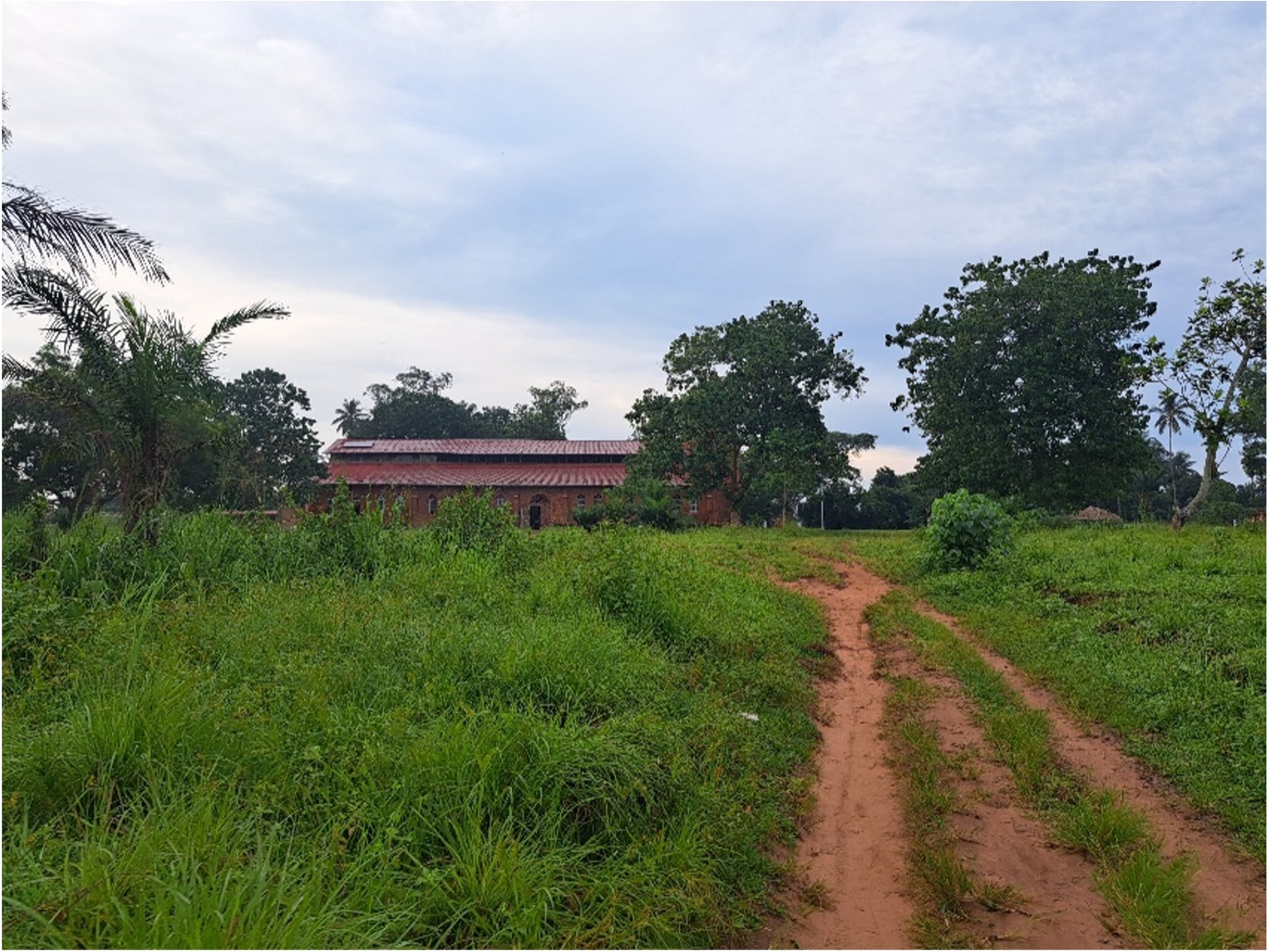
The city of Kikwit consists of twelve parishes – eleven on the left bank of the Kwilu River, and one on the right bank: Kikwit Sacré Cœur, the old missionary heart of the region. The right bank could not be more different from the vibrant commercial urban center on the left bank. After crossing Pont Kwilu, the little market stalls that characterize the Bas-Villeof Kikwit slowly disappear, until the asphalted road turns into a sand road and the bustle of the city makes place for the tranquility of the forest. On the right bank, farmer families live in the literal shadows of forest vegetation, monasteries, churches, and Catholic educational institutes. Many congregations organize the formation of young sisters in Sacré Cœur, safely separated from the city center and its many temptations. The Sœurs de Saint-André de Tournai run the Lycée Siama on the right bank, a large and prestigious secondary school for girls. I spent a weekend there, which happened to coincide with the culmination of the Semaine Missionnaire Mondiale, a global annual festivity dedicated to Catholic missionary works.
On the eve of Dimanche de la Mission, the week’s climax, the Saint-André community (two sisters, Murielle* and Carole*, two aspirants, and three students) and I gathered together in the chapel of the community for the evening prayer. After the usual components – about five prayer songs in French accompanied by drums and shakers, a Lord’s prayer, and a few Bible readings – sister Murielle initiated a new element for the occasion. In the light of the week’s celebrations, everyone had to state a few topics they wanted to pray for specifically. While sister Carole and the two aspirants drew attention to things such as illness, good health, and education, sister Murielle took the time to thank all the missionaries who, many years ago, came to Congo “pour servir et pour announcer la Bonne Nouvelle”, even if it sometimes cost them their lives.
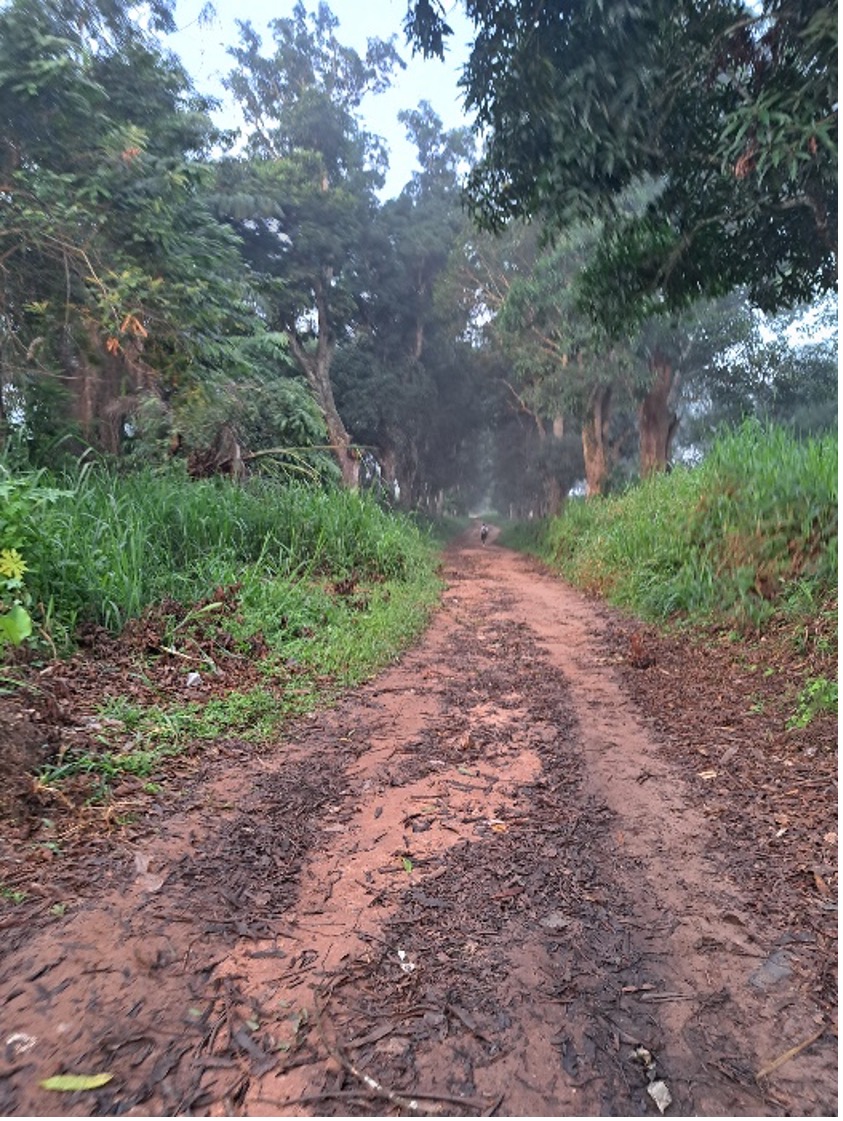
On Sunday morning, we all left for the special mass dedicated to the celebration in the church of Kikwit Sacré Cœur. I followed sister Carole across the sandy path. She was warmly greeting the other churchgoers while carefully avoiding the mud puddles created by that night’s rain and the rotting mangoes that had fallen off the trees, covered with flies. After a ten-minute walk in the morning dew, we reached the church of Kikwit Sacré Cœur, which was very crowded for the occasion. The students of the boarding school of Lycée Siama filled the entire nave of the church, while the front was occupied by the choir of novices. The many sisters, friars, and fathers of the parish mixed with ordinary churchgoers in the side aisles. On the left of the altar, a band was trying to connect their instruments to a sound system, occasionally causing a loud beep or boom to come from the boxes. It promised to become an exciting few hours, not in the least because this year’s Dimanche de la mission coincided with the welcoming of the new seminarists of the diocese.
Unlike the other masses I had been to, this one was not going to be held in French, and the few Kikongo words and phrases that one of my dear colleagues in Leuven taught me before my trip were insufficient to understand everything that was going on. I picked up a few “matondo mingi”-s (thank you so much) and “Mfumu Nzambi”-s (God), but it was mostly people’s body language (and sister Carole’s translations) that told me what to do and what to make of the mass. At a certain point in the three-hour mass, however, the priest switched to French and said: “Nous sommes tous des missionnaires”. He emphasized that mission is everyone’s concern and that every single Catholic was sent to live the Gospel. For the occasion, the sign of peace that is usually exchanged between the churchgoers somewhere right before the communion was replaced by a missionary encouragement: the attendees had to turn to each other and call each other “missionnaires”. They did so enthusiastically, shaking hands and smiling widely. It took a while for the church to go quiet again so the mass could proceed.
Through these rituals, tensions between the past and the present, the global and the local, and dependence and autonomy run quietly. Congolese Catholics have to simultaneously navigate feelings of indebtedness to the Western missionaries who introduced the Gospel in Congo and a sense of belonging to a global Church on the one hand, and the Church’s links to colonization, its hierarchical organization, and a Greco-Latin ritual orientation on the other. However, the Kikwitois sisters appear to have adopted quite functional strategies to overcome these tensions. For one, many of them distinguish the “first wave of missionaries”, who are identified as accomplices to Leopold II’s exploitative regime, from the second wave of missionaries operating under the Belgian authorities. Because the mission of Kikwit was founded in 1912, four years after the Belgian king had to cede his private colony to the Belgian government, and sister congregations only started arriving after 1922, this distinction allows for the sisters to redirect critical thoughts away from the histories of their own institutes, which already decompresses a great deal of tension.
Secondly, the Vatican has been putting a lot of effort into the redefinition of “mission”, and, as the Dimanche de la Mission mass illustrated, the Catholic community in Kikwit receives this with joy. Rather than speaking in terms of apostolate, congregations now refer to their members’ worldly tasks as individual “missions”: sister Carole, who was born in a village in Katanga and had mostly lived in the congregation’s community in Lubumbashi, was sent (“envoyée”) by the mother superior to Kikwit to manage the secondary school in 2018. In fact, every single person is sent to serve – everyone is missioned to contribute, to society, the local Church, and global Catholicism.
*The blog post refers to individual sisters with pseudonyms.

 congo research network
Discussion
Trackbacks/Pingbacks
Pingback: Catholic Sisters in Postcolonial Kikwit – Part 2 | congo research network - May 15, 2024