Why would a Chinese PhD student choose to conduct anthropological research in Congo? How did he secure access to the field? Do Chinese-Congolese couples exist, considering the “self-segregation” of the Chinese in Africa? How does a Chinese ethnographer navigate his identity and positionality with both Congolese and Chinese informants in the field?
In a series of four blog posts, Cai Chen, a PhD student at the Université libre de Bruxelles, provides insights from his ethnographic fieldwork experiences in the course of his ongoing doctoral research on Chinese-Congolese couples residing in Congo.
A Chinese Ethnographer in DR Congo: Reflections on the Field and Fieldwork
[Part 4] A “Developed” Chinese: Negotiating Multi-faceted Field Relations
My initial fieldwork experience in Kinshasa proved to be extremely challenging. Despite Liyuan’s assistance in reaching out to a Chinese man who had married a Congolese woman, my request for a meeting was declined. However, he agreed to respond to some questions through messages on WeChat. Additionally, not knowing anyone else in the city and grappling with the exorbitant cost of living in Kinshasa (where, for instance, a cappuccino cost me $7), posed significant challenges. This financial strain was particularly burdensome for an ethnographer whose fieldwork was not funded. Consequently, just ten days later, I made the decision to relocate to Lubumbashi, where I found a more affordable accommodation with the help of Brother Li.
On the eve of Christmas 2022, my Congo Airways flight, initially rescheduled and then delayed for over eight hours, finally took off from N’djili Airport at 1 am and landed in Lubumbashi at 4 am the next day. While domestic flights usually do not involve passport control upon arrival, I, as the only visibly Chinese passenger, was stopped by immigration. This occurrence did not surprise me, given the prior warnings from Liyuan, Brother Li, and my ‘translator’ friends. They had all reminded me to carry some change and cautioned about the targeted extortion of Chinese individuals by immigration officers at Lubumbashi airport, irrespective of the orderliness of their travel documents.
With a quick “Morning!” I handed over my passport and remained silent to see what was going to happen. The officer checked my document carefully, then looked at me, saying “makuta” (money in Kiswahili) with a “pay me” gesture. I was taken aback by the directness, a behaviour I hadn’t encountered in other African countries. In response, I pulled out my invitation letter, pretending not to understand the word and the gesture. In French, I said, “Here you are, my invitation letter. Is this what you want?” Realizing that I was an invited researcher who spoke fluent French, she appeared surprised but persisted in attempting to solicit money, this time wishing me “Happy New Year!” Feeling increasingly unhappy and impatient, especially with an exhausted body at 4:30 am after the extensive delay of my flight, I replied, “No, no, today we say Merry Christmas! If you don’t have any more questions, may I leave now?” Unpleasantly, the officer returned my passport and remarked, “You aren’t like other Chinese!”
Brother Li picked me up at the airport with his driver and took me to what he introduced as “a semi-open hotel of one of his friends, Sister Liu”. When we arrived, it was already 5:30 am, and a power cut was in progress. Exhausted, I went straight to sleep. I’m not sure how many hours later, I was startled awake by the sudden opening and closing of the door and an African woman screaming, “Ah, there is someone in the room!” However, I simply rolled over and went back to sleep. Finally waking up around 11 am, I showered before venturing outside my room into the courtyard. I spotted a Congolese woman washing clothes near a door adorned with Spring Festival couplets—a typical ‘Chinese’ door. As she noticed me approaching, she greeted me in French. Jokingly, I replied, “Good morning, was it you who opened my door and interrupted my dream?” She burst into laughter and surprisingly responded, “Oh, I’m sorry, I didn’t know anyone was there. Aie, how come you speak French so well? Are you French?” “No, I’m Chinese like others here, and this is a place for the Chinese, isn’t it?”, I replied. She explained, “Because you could speak French, and the other Chinese here only speak broken Chinese-style Kiswahili.”
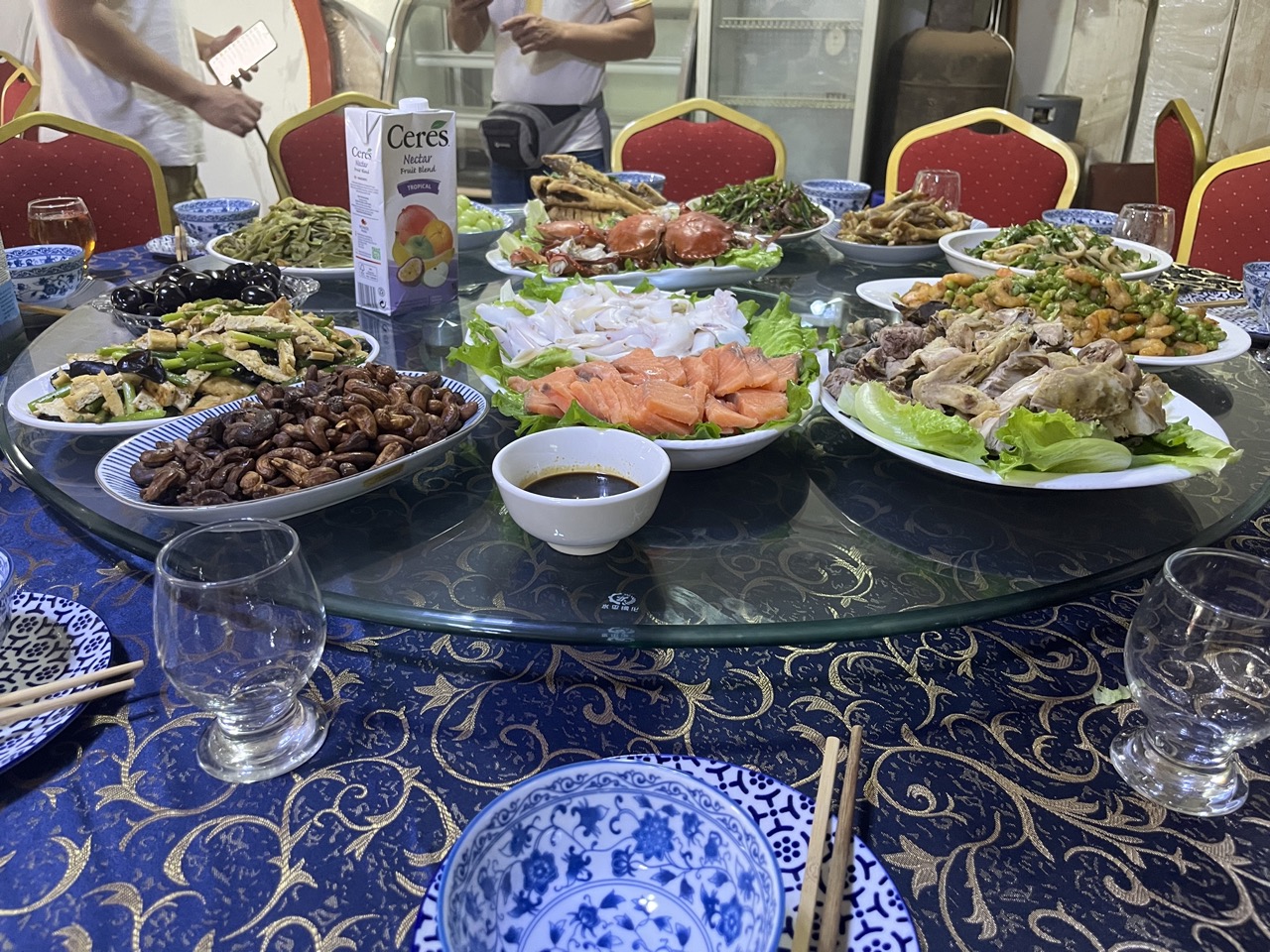
In the following days, all the Congolese workers in the courtyard—including two housekeepers, a security guard, and several drivers—shared with each other and told Congolese visitors that “this Chinese is different; he speaks French, greets, and talks to the Congolese; he studies in Brussels!” On separate occasions, my Congolese interlocutors commended me as a “developed” Chinese contrasting me with others they perceived as “poorly educated, badly dressed, speaking neither French nor English, and always ignoring people when they greet them”. However, this perceived ‘difference’ elicited negative reactions from a group of Chinese traders and entrepreneurs also residing there. During our initial group meal, I revealed that I was a PhD student in Belgium on a scholarship (albeit a one-year one) and that I was interested in the lives of Chinese-Congolese couples. Regrettably, the fact that I was “funded by the Belgian government” was misinterpreted, leading to the assumption that I was “working for foreign forces” and “reporting on the indecent sexual relationships of the Chinese in Belgium’s former colony”.
As a PhD student residing in Europe, my social and cultural position accentuated the social distance with my Chinese interlocutors, many of whom come from rural or working-class backgrounds. They often referred to me as “daxue sheng” (college student), rather than using my name or “xiao chen” (Chen junior), a term reserved for the more privileged individuals with a university education in China. Despite this, coming from rural milieu myself, I was familiar with their sociability and language. To bridge the social gap, I made concerted efforts such as sharing meals, adjusting my language register, and even altering my hairstyle (from a trendy, slightly long haircut to a finger length) to foster a more authentic connection. Moreover, I extended my assistance with translation or IT needs. In contrast, the dynamics with those working as ‘translators’ in large Chinese companies were different, given that they all received higher education like me at the time and speak decent French.
* Cai Chen is grateful to Prof. Katrien Pype (KU Leuven), coordinator of the Congo Research Network, for her kind invitation and invaluable comments and editing suggestions. These blog posts have been adapted into a methodology note in French, published in the issue n° 288 of the journal Suds : Géographies critiques, perspectives des Suds.

 congo research network
Discussion
Trackbacks/Pingbacks
Pingback: A Chinese Ethnographer in DR Congo – Part 3 | congo research network - February 22, 2024
Pingback: [Publication] Blog post: A Chinese Ethnographer in DR Congo | BelMix - February 22, 2024